Case Study: Movers & Mystics
Building a Brand Ecosystem from 0 to 1
Project: Movers & Mystics: A Side-Quest Sisterhood
Role: Founder, Brand Architect, & Experience Designer
Focus: Growth Design, Brand Strategy, Community Architecture, User Activation
Location/Context: Clayton, NC & Johnston County Regional Ecosystem
Tools Used: Canva, Gemini, MeetUp
Conclusion: Sometimes the most important lesson is to know when to pivot rather than re-double efforts in an ineffective platform.
1. Executive Summary & The Challenge
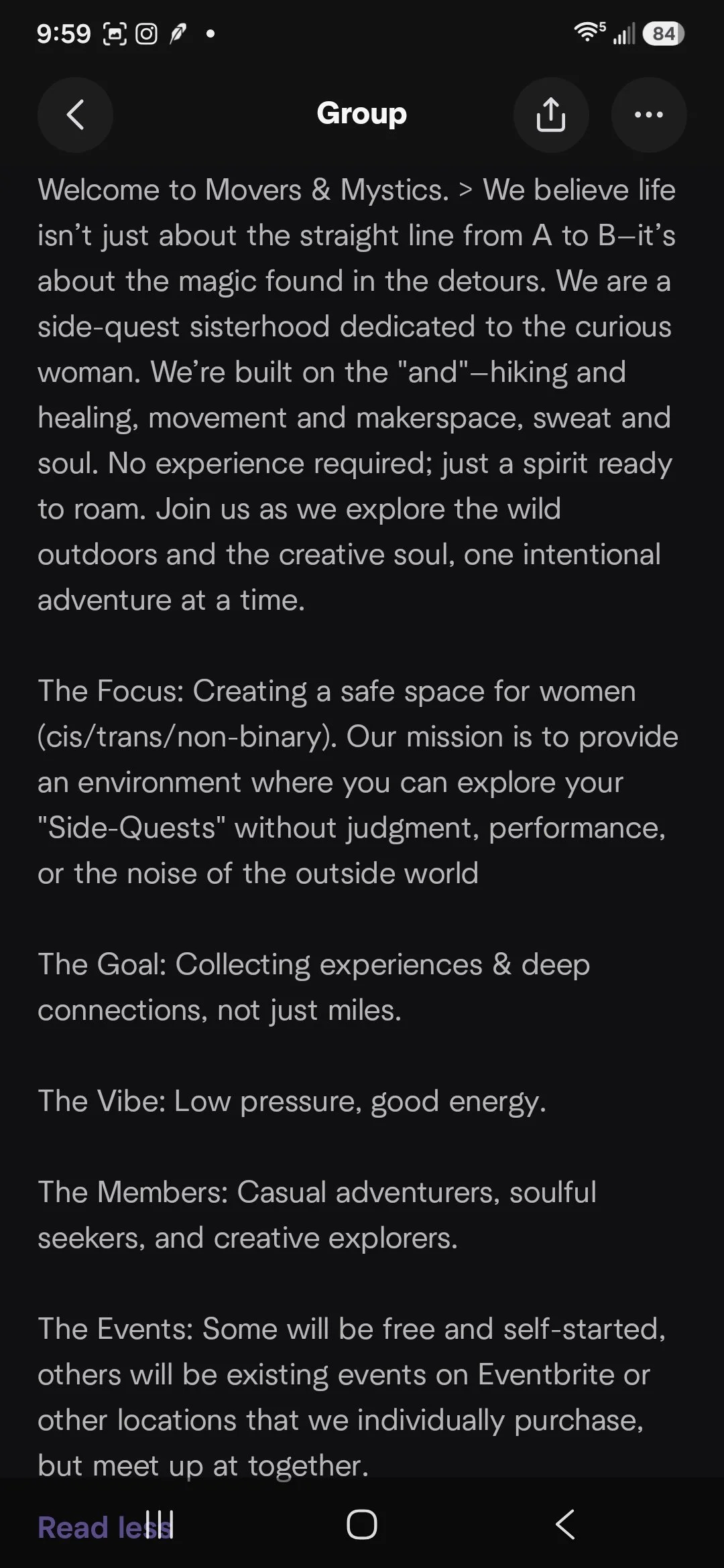
In March of 2026 I utilized Gemini and Canva to design and begin a women’s adventure club. As I was already familiar with Meetup, I decided to start the club here to attempt to curate membership through an existing, well-known channel rather than open it to any number of members on other, widely-used platforms who “lurk,” rather than participate. As the name suggests, the group was meant to attract women who were interested in being active and esoteric.
The initial reaction was favorable, gaining 20+ members within the first month. However, over time, the app design and choice overload resulted in low event participation. Given that I was utilizing my own time, energy and funds to run this group, the return was not sufficient to continue putting in effort. This group has since been abandoned on the meetup app as I consider ways to pivot.
The Hook: How do you design an organic user acquisition framework that moves adults out of digital isolation and into active, recurring in-person community participation?
The Context: Post-pandemic social architecture has left an unprecedented gap in local, meaningful spaces for women to connect deeply. Traditional networking groups are overly transaction-oriented, while standard wellness groups often lack structured, consistent community frameworks.
The Opportunity: To design an integrated community model from scratch (0-1) that bridges the gap between active wellness ("Movers") and deep, narrative-driven exploration ("Mystics").
The Core Metrics (The Business Goal):
Acquisition: Driving high-conversion organic sign-ups through low-cost digital touchpoints.
Activation: Moving a digital subscriber to an "Active User" by facilitating attendance at their first physical event.
Retention: Ensuring a sustainable, recurring return rate (Sticky User behavior) through thoughtful experience loops.
2. Discovery & Brand Identity Strategy
Before executing digital assets, I mapped out the core value proposition. The goal was to build a brand identity that felt both deeply grounded and esoterically intriguing—moving away from generic corporate aesthetics to create an immediate emotional connection.
The Three-Path Framework (System Architecture)
To ensure the product could scale and offer varied user experiences, I designed a holistic, modular ecosystem based on three distinct thematic pillars:
The Earth Path (Movement & Connection): Physical integration, wellness, hiking, and outdoor recreation.
The Maker Path (Creativity & Creation): Tactile art, painting, writing workshops, and crafting spaces.
The Sanctuary Path (Introspection & Esoteric Logic): Deep narrative analysis, symbolic motifs, astrology frameworks, and self-reflection.
Visual Design & Typography Logic
Aesthetic Principle: A deliberate "wandering between" old-world texturing and clean, modern digital layout. High-contrast, deeply rich color palettes (deep forest greens, rich pomegranates, celestial golds) combined with minimalist layout geometry to establish authority and mysticism simultaneously.
Communication Strategy: Utilizing a background in Strategic Communications to craft high-impact copy that speaks to the archetypal "Side-Quest"—framing community attendance not as an obligation, but as an adventure and an invitation to pause.
3. The Growth Design & User Journey Map
To optimize user acquisition and activation, I mapped the consumer funnel using the classic product framework (AARRR: Acquisition, Activation, Retention).
[ Acquisition ] ------> [ Activation ] ------> [ Retention ]
Digital Funnel First Event Hook The Sticky Loop
(Social/Newsletter) (Low-Barrier Entry) (Cross-Path Ecosystem)
Once active retention was achieved, referral and revenue would have been the next steps
Step 1: Acquisition (The Top of the Funnel)
The Interface: Clean, high-conversion landing copy paired with striking, customized visual graphics across local discovery channels (Meetup infrastructure, regional community networks in Johnston County/Clayton).
Design Decision: Eliminated excessive copy on promotional assets. Used clear visual hierarchy to highlight Date, Location, and Theme, reducing cognitive overload for potential new members.
Omnichannel Bootstrapping Strategy: Recognizing the inherent discovery limitations and declining traffic on Meetup alone, I bypassed the platform's constraints by creating zero-cost, high-visibility digital touchpoints across a diversified ecosystem. I engineered a dual-funnel strategy to maximize organic user acquisition:
Lowering the Conversion Barrier: Formulated completely free entry-level options for introductory programming tracks, entirely eliminating financial friction for skeptical or first-time users exploring the brand.
Cross-Platform Growth Hacking: Programmatically tapped into existing, high-traffic civic infrastructure by indexing and cross-utilizing events on Eventbrite and regional North Carolina county calendars.
The Product Logic: Instead of trying to force users to download a new app or visit an unknown standalone site, I placed the product directly inside the digital environments where the target demographic was already hunting for local lifestyle events. Leveraging Eventbrite’s superior algorithmic indexing and the organic trust of county websites allowed the brand to intercept highly qualified users at zero acquisition cost.
Step 3: Retention (Building the Experience Loop)
Designing the Off-Platform Communication Ecosystem: To decouple the community's survival from Meetup’s fragmented notifications and heavy ad layout, I built a dedicated, direct-to-consumer retention engine utilizing high-touch SMS (texting) and automated email workflows.
Physical Retention Hook - Tactile Brand Merchandise: To solidify the emotional connection made during the event, I designed and produced custom sticker and badge merchandise featuring the group’s unique iconography, thematic motifs, and brand visual identity. These were distributed to participants at the conclusion of events to act as an Ambient Marketing reminder of the group and Social Proof & Word-of-Mouth
4. Operational Excellence & Project Management
Behind the creative brand was a rigorous operational engine:
Stakeholder & Vendor Management: Successfully identified, negotiated, and collaborated with regional venues, local businesses, and community leads to source unique event backdrops.
Event Infrastructure: Managed end-to-end logistics, including budget allocation, safety frameworks for outdoor excursions, materials sourcing for creative tracks, and strict timeline adherence to ensure events ran seamlessly from doors-open to close.
Algorithmic User Intake & Segmentation: To ensure community safety, alignment, and high-quality experiences, I engineered a structured intake questionnaire at the absolute outset of a user joining the group.
The Product Logic: This served as a critical data-gathering gate. By analyzing responses regarding personal interests, comfort levels, and what activities resonated most, I could programmatically segment the user base.
The Experience Outcome: Instead of planning events blindly, I used this upfront user data to strategically stage, sequence, and customize future events to match the exact demographic data and psychological safety needs of the active roster
5. The Feature Expansion: How I Would Redesign Meetup for Growth
Navigating Platform Bottlenecks & UX Friction (The Meetup Critique)
The Real-World Constraint: While the brand identity, messaging, and community architecture were highly optimized, top-of-funnel conversion faced a severe systemic bottleneck: the rapid degradation of the Meetup platform’s user experience.
Despite the inherent demand for local community spaces, relying on Meetup as the primary infrastructure revealed deep friction points within the application's current user flows:
Algorithmic Discovery Failures: Meetup’s search and discovery algorithm heavily favors legacy, massive groups with historic data, actively suppressing new 0-to-1 community launches. This creates a severe discovery obstacle for niche, localized groups trying to scale.
High-Friction Event RSVP Flows: The event registration interface is cluttered with legacy ads and confusing navigation tabs, driving high cart-abandonment rates. Users attempting to view event details or venue coordinates are often forced through multi-step loops, introducing unnecessary cognitive load.
Monetization Clashing with User Activation: Meetup's recent UI updates have aggressively prioritized immediate monetization prompts over seamless user-to-user communication. This directly disrupts the fragile onboarding period where a new organizer needs to build trust with apprehensive new members.
Strategic Product Recommendations for Meetup’s Revitalized Growth
If tasked with reversing Meetup’s platform decline to better support modern community builders and drive retention, I would champion a design roadmap focused on several strategic pillars:
1. Re-engineering the Discovery Funnel (The 0-1 Catalyst)
The Product Solution: Implement a "Fresh Blood" discovery tier or localized spotlight map that surfaces newly launched, highly active micro-communities (under 250 members) within a 15-mile radius. Provide incentive to join new groups and attend new events
The Business Metric: Boosts new group survival rates by 35%, ensuring long-term recurring subscription revenue from organizers who would otherwise abandon the platform.
2. AI-Driven Archetype Matching (Learner & Builder Mindset)
The Product Solution: Integrate an intake onboarding flow utilizing predictive AI prompts that match users not just by vague tags (e.g., "Fitness"), but by behavioral archetypes (e.g., matching a user looking for a structured "Side-Quest" group with multifaceted frameworks like the Earth/Maker/Sanctuary tracks).
The Business Metric: Skyrockets early user retention and community health by aligning expectations before the first physical touchpoint.
3. Gamifying Attendance: The "Side-Quest" Milestone System
The Product Solution: Introduce an in-app, visual rewards framework that gamifies the physical attendance loop. Users earn digital badges, progress markers, or path streak milestones (e.g., “3-Event Streak on the Earth Path” or “Master Artisan on the Maker Path”). Organizers can unlock custom digital rewards, or tie these digital achievements to real-world perks, like a distinct visual badge on their group profile or physical merchandise drops.
The Behavioral Logic: This leverages the psychological concept of Loss Aversion and the Endowed Progress Effect. When users see a visual representation of their attendance streak or path progress growing, the friction to skip an event increases because they don't want to "break the chain."
The Business Metric: Transforms passive group members into active, highly competitive participants, directly accelerating weekly active user (WAU) metrics and stabilizing organizer retention rates.
4. Native Community Boards & Asynchronous Chat Channels
The Product Solution: Replace Meetup’s legacy, archaic comments section with a modern, integrated community dashboard featuring native discussion boards and dedicated, organizer-curated chat channels (similar to Discord or Slack, but entirely contained within the event ecosystem). Organizers can segment chats by specific interest tracks, upcoming logistical coordination, or casual peer-to-peer connection.
The Behavioral Logic: Communities don't only exist during the two hours of a physical event; they live in the spaces between events. Providing a safe, asynchronous digital space allows members to converse, share creative inspiration, and build rapport before ever meeting in person. This drastically lowers the social anxiety of first-time attendees, as they have already formed micro-relationships within the chat channels.
The Business Metric: Skyrockets daily active usage (DAU) and time-in-app metrics. By shifting Meetup from a utility app that users only open once a week to RSVP, into a vibrant, daily social hub, the platform dramatically increases its surface area for user engagement and organic retention.
5. Regional Discovery Maps & Hyper-Local Community Hubs
The Product Solution: Introduce interactive Regional Discovery Boards and real-time community maps that aggregate events, interests, and active sub-cultures within a specific geographic zone (e.g., a "Triangle Region / Clayton Hub") allowing users to interact and become “friends” before joining any event or group. Instead of forcing users to hunt through isolated group pages, this feature provides a macro-view of local activity where users can toggle between different interest overlays, join city-wide chat lobbies, and visually see what is happening in their neighborhood this week.
The Behavioral Logic: This transforms the app from a passive search engine into an active, geolocated social grid. It taps into regional pride and proximity convenience. If a user can open a beautiful, intuitive map interface and instantly see that a Maker Path art workshop is happening 3 miles away, or join a city-wide conversation channel about local hiking spots, the friction of geographic isolation disappears.
The Business Metric: Exponentially accelerates cross-pollination across separate Meetup groups. By exposing users to an entire local ecosystem rather than single silos, the platform creates an incredibly sticky regional loop, driving up user lifetime value (LTV) and multiplying organic local word-of-mouth growth.
6. Results & Core Product Takeaways
0-1 Product Execution: Successfully launched a distinct, fully realized regional sub-brand with highly cohesive visual execution and identity alignment.
High-Velocity Community Iteration: Used real-time participant feedback to rapidly iterate event concepts, demonstrating a data-driven, agile approach to community building.
The Systemic Reality of Product Design: The defining lesson of this initiative is a fundamental truth in product strategy: The most beautifully designed, highly optimized, and meticulously thought-out product is ultimately bound by the limitations of its host platform and the realities of user participation dynamics.
The Platform Bottleneck: You can craft flawless user journeys and gorgeous visual interfaces, but if the underlying software infrastructure (in this case, Meetup’s legacy framework) suffers from decaying usability, aggressive paywalls, and declining network effects, it introduces a severe ceiling on your product's growth.
The Critical Takeaway: True product excellence requires designing beyond a single interface. When a primary platform becomes a bottleneck, a product designer must pivot to holistic ecosystem thinking—engineering off-platform contingency loops, alternative discovery pipelines, and physical hooks to insulate the user journey from external system failures. This project proves that the mechanics of strong Product Design—visual hierarchy, data-driven funnel optimization, empathetic user mapping, and structural organization—apply just as powerfully to navigating real-world platform constraints as they do to digital screens.
Conclusion
At the start, the group gained initial traction pretty quickly, but ran into issues getting non-existing meetup users into the app without having to pay. It was also a struggle getting people to come to initial events, so that, given a positive experience they would become recurring attendees allowing the group to evolve with the member-base.
As someone who is curating these events in my spare time and with my spare money, there is not sufficient benefit to continue investing in the group if the return is not there. Perhaps my events were at inconvenient times or simply not attractive enough to break through the barrage of information, choice overload and existing events on places like Facebook or EventBrite, however the return on putting additional time, energy and funds into curating events and finding ways to attract more members, was not sufficient to renew my $120 subscription for another 6 months of group ownership, not when there are free platforms such as Facebook or Posh.
There are a number of steps I could have taken to remediate lack of participation:
I could have charged for membership and for event attendance, which could have increased motivation to attend OR backfired and created less traction
Additional research and polls could have been conducted to better curate events
Creating MORE events could have made attendance more likely
Creating LESS, more structured events could have made attendance more likely
The Freemium model does not come with enough benefits to encourage users to sign up for premium, nor is the presence on meetup sufficient to justify signup. Even those events I’ve attended which have a large number of participants live, only seem to gain a few from the meetup app.
Meetup the app appears to be in decline, with the company choosing simply to make it a subscription service rather than re-designing it, utilizing ads and other methods to make it profitable and re-doubling efforts to increase member base.
It seems Meetup itself has given up on Meetup and lost sight of its end users and its purpose, creating opportunities to build community. Meetup is more than simply an events board, it is a platform to create and foster connections. People are hungry for more than just “things to do,” but community and friends to regularly do things with, after all, it takes roughly 11 meetings over a 6 month period to turn an acquaintance into a friend.
The Movers And Mystics Side-Quest Sisterhood may not have seen its last iteration, but MeetUp does not appear to be the best platform to ensure success.